Large-scale manufacturing makes component sourcing a strategic cost decision. For OEMs that integrate heating systems into HVAC equipment, medical devices, cold chain units, or cabinet appliances, the purchase price of a heater is only one part of the equation. Consistent specifications, installation efficiency, supply continuity, and customization can all affect total manufacturing costs. For this reason, sourcing through a wholesale PTC air heater program can offer advantages beyond volume pricing.
Looking Beyond the Unit Price
OEM purchasing teams often focus first on the quoted price per component. However, a lower unit price does not automatically produce lower overall costs. Variations between batches, additional installation work, unsuitable dimensions, or frequent engineering changes can create hidden expenses during production.
A more strategic sourcing approach evaluates the complete component lifecycle. A PTC air heater that combines suitable power, voltage options, mechanical integration, and stable operation can reduce the need for repeated modifications. For high-volume programs, even small improvements in assembly efficiency can become meaningful across thousands of units.
Why PTC Heating Supports Efficient Design
PTC technology is attractive for many air-heating applications because its positive temperature coefficient allows the heating element’s electrical resistance to increase as temperature rises. This characteristic supports self-regulating heating behavior and can help reduce dependence on complicated temperature-control arrangements.
For OEM designers, the technology can provide a practical balance between heating performance and control simplicity. PTCYIDU’s published product information describes its PTC heating solutions as suitable for heating and dehumidification applications, while its product portfolio includes conductive and insulated PTC air heaters, fan heaters, aluminum shell heaters, and thin film heaters.
Wholesale PTC Air Heater Purchasing and Volume Economics
Bulk sourcing becomes particularly valuable when an OEM has predictable production requirements. Larger purchasing programs can simplify procurement, reduce the number of supplier transactions, and make component planning easier. Instead of repeatedly purchasing small quantities, buyers can establish a standardized specification for a production program.
The important consideration is not simply ordering more units. OEMs should confirm that the supplier can maintain the required specifications across production batches. Manufacturing capability, testing procedures, lead times, and customization support should therefore be evaluated alongside pricing.
Multi-Voltage Options Can Simplify Product Planning
OEM manufacturers may produce equipment for different markets, where electrical requirements can vary. A heating component available across multiple voltage configurations can reduce the need to redesign the heating section for every product version.
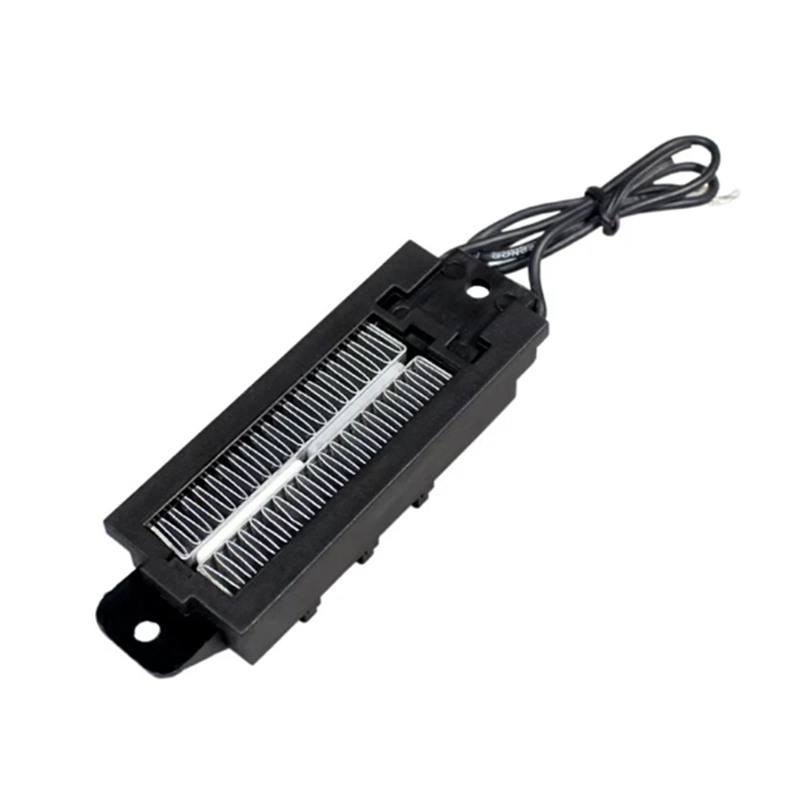
The relevant PTC heater specification published by the manufacturer supports rated voltages from 12V to 220V and rated power from 50W to 200W, with the stated power rating measured at R=24°C and an airflow velocity of 3.3 m/s. Its listed size is 92 × 31 × 25 mm.
This range can give purchasing teams more flexibility when planning components for different equipment configurations. However, the correct voltage and power combination still needs to be selected according to the actual application and electrical design.
Mechanical Integration Also Affects Manufacturing Cost
A heating component that is difficult to install can increase assembly time even when its purchase price is competitive. Mounting arrangements, dimensions, wiring, airflow direction, and available installation space all influence how easily a component can be incorporated into a finished product.
A bracket-mounted design can help simplify mechanical installation where the enclosure and mounting structure are designed around it. For OEM projects, the ability to customize dimensions, voltage, power, and other parameters can be particularly useful because it allows the heating solution to better match the equipment architecture rather than forcing unnecessary redesign.
Stable Supply Matters at Production Scale
Production interruptions can cost considerably more than a small difference in component pricing. If a heating component is unavailable when an assembly line requires it, OEMs may face scheduling delays, emergency purchasing, or changes to production plans.
A supplier with established manufacturing processes can provide greater visibility into production planning. PTCYIDU states that its manufacturing process includes PTC screening and pairing, wire processing, assembly, compression molding, surface-temperature testing, electrical-performance testing, and final packaging.
Such process stages provide purchasing teams with a useful framework for evaluating production consistency before committing to a long-term sourcing arrangement.
Customization Can Reduce Engineering Compromises
Standard components can be suitable for straightforward applications, but OEM equipment frequently has application-specific requirements. A heater may need a particular power level, voltage, size, mounting arrangement, or airflow configuration to fit the finished product.
Direct cooperation with a manufacturer can make these requirements easier to communicate and evaluate. PTCYIDU reports that its customization process includes requirement confirmation, design and quotation, sample production, testing, mass production, and final delivery. The company lists typical sample lead times of 3–7 days and mass-production lead times of 15–20 days, depending on specifications and order quantity.
Applications Influence the Right Sourcing Strategy
The same heating technology can serve very different equipment categories, so OEM buyers should evaluate the component against its actual operating environment. HVAC systems may prioritize airflow and continuous operation, while medical equipment can place greater emphasis on controlled heating and integration. Cold chain equipment may have different space and environmental requirements.
The manufacturer’s application portfolio covers HVAC systems, industrial equipment, automotive applications, home appliances, consumer electronics, and agriculture. Its listed applications also include 3D printers, cleaning machines, vending machines, pet dryers, and other equipment.
Making Cost Reduction a Long-Term Strategy
For large-scale OEM manufacturing, the best component cost is rarely determined by the initial quotation alone. A more complete calculation should consider procurement volume, engineering changes, assembly requirements, quality consistency, inventory planning, and supply reliability.
A well-matched PTC heating solution can contribute to this broader cost strategy by combining self-regulating heating characteristics with flexible electrical and mechanical options. When purchased through a structured wholesale arrangement, these benefits can become more valuable as production volumes increase.
A Practical Path for High-Volume Heating Procurement
PTCYIDU is the brand associated with Shanghai Yidu Electronics Co., Ltd., a PTC heater manufacturer established in 2002. Its product range includes conductive PTC air heaters, insulated PTC air heaters, fan heaters, aluminum shell heaters, and thin film heaters.
For OEMs evaluating high-volume heating components, the company’s 50W–200W, 12V–220V PTC heating element provides one example of how flexible electrical specifications can support different equipment requirements. Combined with OEM customization capabilities, such solutions can help manufacturers approach component sourcing as a long-term cost and engineering strategy rather than a simple price comparison.
