Indoor display projects often reach the same decision point from different directions. One project begins with close viewing and high detail, another with service access, another with standard video proportions, and another with the need for a protected display surface.
Because these priorities do not carry equal weight in every room, the useful comparison is the one that identifies which characteristics solve the dominant project constraints instead of declaring one technology “best” in isolation.
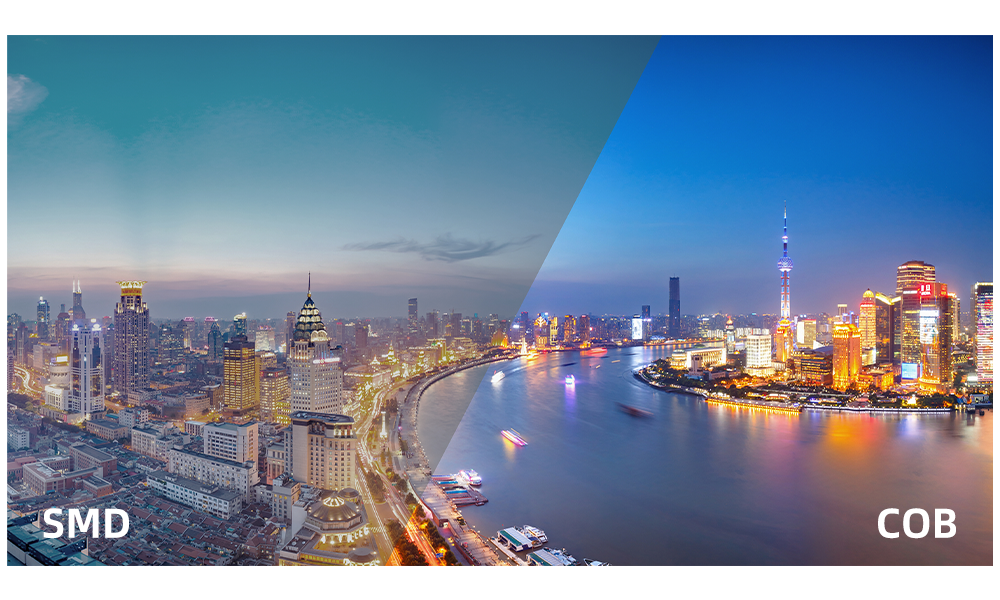
HDC‘s supplied indoor specifications place SMD and COB side by side with different pitch ranges, cabinet formats, contrast figures, structural approaches, and protection characteristics. Comparing an indoor LED display across those dimensions creates a more practical basis for selection than treating SMD and COB as competing labels.
Project Constraints Should Lead the Comparison
Before the two technologies are scored, the project should define what cannot be compromised. Required pixel pitch, cabinet aspect ratio, contrast, surface protection, maintenance conditions, and the intended service environment form the main decision variables in this comparison.
An indoor LED display used for a very fine-pitch wall may place pixel density near the top of the list, while another installation may favor a familiar cabinet format and straightforward front service. The comparison also needs to account for how the finished wall will be proportioned.
A system intended around standard Full HD, 4K, or 8K layouts has different geometric priorities from one designed to fill a custom architectural opening. By ranking these requirements before reviewing product families, the project team avoids giving every specification the same importance.
SMD Provides a Consistent Cabinet and Service Profile
Across the SMD range, five pitch options—1.2, 1.5, 1.8, 2.0, and 2.5 mm—share a 640 x 480 mm cabinet format. The supplied specifications include a 3840 Hz refresh rate, 600 cd/m² brightness, a stated 5000:1 contrast ratio, 160°/140° viewing angles, and full front maintenance.
For an indoor LED display, this combination can be assessed as a system profile rather than a list of isolated advantages. The common cabinet format gives planners a consistent physical building block across several pitch choices, and front maintenance is relevant when rear access is limited.
The brightness level is intended for an indoor environment rather than outdoor sunlight, while the wide viewing figures matter where audiences are not concentrated on a narrow centerline. SMD therefore presents a set of known integration characteristics that can be matched against the room and service strategy.
COB Prioritizes Finer Pitch, Surface Protection, and 16:9 Geometry
The COB range moves the comparison in another direction. HDC lists 0.78, 0.93, 1.25, 1.56, and 1.87 mm pitches in 600 x 337.5 mm cabinets with a native 16:9 aspect ratio.
Surface protection in this COB design comes from integrating the LED chips directly on the PCB and then encapsulating the display surface. The native 16:9 COB format is intended for standard Full HD, 4K, and 8K wall construction; selected versions add a stated contrast of up to 20,000:1 with 160° viewing.
In an indoor LED display project, those characteristics may carry more weight where extremely fine pitch, video-native proportions, high contrast, or surface protection are central. The highlighted flip-chip COB design reduces single-pixel failure rates and can lower energy consumption. Those characteristics apply to the highlighted design and should not be generalized across all COB configurations.
Turn the Comparison into a Decision Matrix
The decision matrix becomes useful only after its rows are tied to concrete project constraints for SMD and COB. If the required pitch is below the SMD range shown, the COB options become relevant immediately.
If cabinet geometry must follow a native 16:9 format, the COB construction offers a direct path. If the plan is built around a 640 x 480 mm cabinet with full front maintenance, the SMD series aligns with that requirement.
Contrast and surface protection can be weighted where they materially affect the application, while viewing angle and refresh should be checked against content and audience layout. HDC supplies enough measurable differences to keep the choice grounded in project conditions rather than product-category preference.
The indoor LED display that fits one room may not be the most sensible choice for another, even when both are technically capable of producing a high-quality image. This keeps procurement focused on the constraints that actually shape installation, operation, and maintenance rather than on a technology label alone.
The comparison therefore ends with fit, not with a universal winner. SMD offers 1.2-2.5 mm pitch choices in a consistent 640 x 480 mm cabinet with 3840 Hz refresh, 600 cd/m² brightness, 5000:1 stated contrast, wide viewing, and front maintenance.
COB extends the pitch range down to 0.78 mm, uses a 600 x 337.5 mm native 16:9 cabinet, adds direct chip-on-PCB encapsulation, and reaches higher stated contrast on selected configurations.
HDC’s two approaches give project teams distinct technical profiles to evaluate. A well-matched indoor LED display is selected by deciding which differences matter in the actual room and which specifications are secondary to the project’s dominant constraints.
