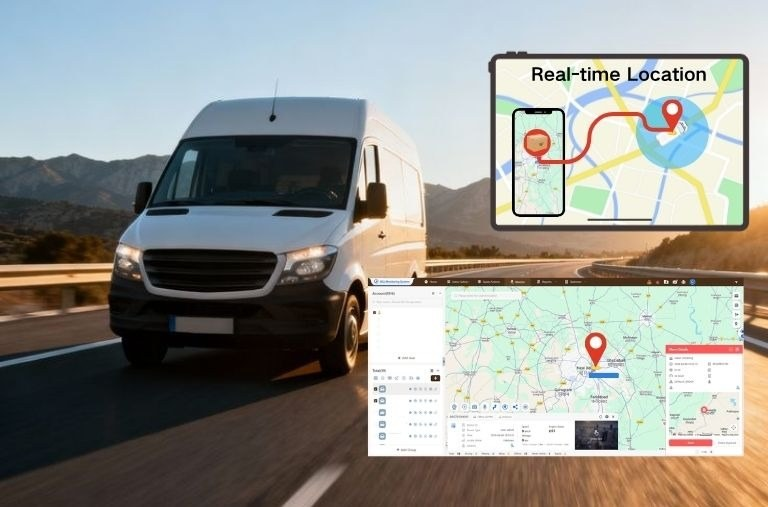
Small commercial vehicles operate on dense schedules with frequent stops, changing traffic, customer time windows, and high driver interaction. Tracking is useful because it gives dispatchers a live operational picture, but raw positions alone do not explain why a delivery is late or why an exception occurred. For dispatch teams, delivery fleet management software should therefore connect location data with route status and event context.
For commercial delivery operators, fleet and delivery management also needs to remain practical at scale. Devices must be easy to install, remotely manageable, compatible with the chosen platform, and capable of providing the level of safety or cargo evidence required by the business.
Track Route Progress Without Overloading Dispatch
The most immediate use of GPS tracking is route visibility. Dispatchers can see which vans are moving, stopped, delayed, or outside an expected area. Route history and geofence events can document arrivals and departures, while live position helps teams respond when a customer asks for an updated delivery status. These functions reduce dependence on repeated driver phone calls.
Good delivery fleet management software should make exceptions easy to identify instead of forcing users to inspect every vehicle continuously. A late departure, prolonged stop, route deviation, or unexpected entry into a restricted area can be highlighted according to business rules. The operator can then contact the driver or reassign work based on current information.
Data frequency also affects the project. Very frequent updates can improve visibility but increase communication and platform costs; slower intervals may be sufficient for low-risk operations. Required alert latency should be specified before the hardware, network plan, and reporting interval are selected.
Installation economics are especially important for light commercial fleets because vehicle counts can be high and margins per stop are often tight. A solution that saves a small amount on hardware but requires substantially more technician time can increase total deployment cost. The pilot should therefore track fitment time, cable routing, commissioning steps, and the rate of installation-related faults.
Route data becomes more useful when it is tied to jobs rather than viewed only as a moving map. Dispatchers can compare planned stops with actual arrivals, identify repeated delay points, and review unauthorized detours. For contracted delivery fleets, those records can also support service verification without requiring a separate manual check for every trip.
Use Video and Driver Events to Explain Exceptions
Video telematics adds context to route and service exceptions. A collision alert can be linked with a video clip, while driver monitoring may identify fatigue, distraction, or other configured behaviors. Cargo-facing or cabin video can also help resolve disputes when the business needs visual evidence. Its practical value comes from event-based access rather than from expecting staff to watch all vehicles live.
Small vans present their own installation constraints because cabin space, power access, windshield layout, and driver visibility differ from heavy trucks. Camera placement should avoid blocking the driver’s view and should be standardized enough for technicians to repeat across the fleet. Device power behavior must also be considered so that monitoring does not create avoidable battery issues during long parking periods.
For light commercial fleets, BSJ Technology describes a combination of 4G-connected GPS tracking, AI dashcams, route visibility, driver-safety monitoring, cargo video evidence, and fleet-health functions. Flexible OEM/ODM arrangements and third-party platform integration are also relevant to distributors and system integrators that want to keep existing software while changing or expanding onboard hardware.
Driver interaction should remain simple. In-cab alerts need to be understandable without creating unnecessary distraction, and any driver-facing screen or indicator should fit the operating policy of the fleet. Training can explain what is recorded, which events trigger alerts, and how the data will be used for safety or operational review, reducing resistance during rollout.
Choose Hardware and Integration for a Scalable Van Fleet
A field evaluation should test more than whether a dot moves correctly on the map. During that evaluation, fleet and delivery management teams can measure installation time, GPS reliability, alert usefulness, video retrieval, data consumption, platform integration, and support response. Those results reveal whether the solution can be deployed to hundreds of vehicles without creating excessive field work or control-room workload.
Remote device administration is particularly important after rollout. Parameters, firmware versions, connectivity status, and device faults need to be managed consistently. When vans operate across several cities or contractors, centralized configuration reduces the risk that different local settings create inconsistent reporting.
Delivery tracking becomes more useful when location visibility is connected to the reasons behind exceptions. GPS supports dispatch, video supports investigation, and integrated software provides the workflow for action and reporting. For small commercial fleets, a scalable solution balances visibility with installation simplicity, communication cost, driver usability, and compatibility with the business systems already in place.
Across different van models, buyers can assess how well GPS and video devices from BSJ Technology fit those requirements. Hardware engineering, fast customization, OEM/ODM flexibility, controlled delivery, and third-party software integration are stated strengths relevant to commercial fleet projects that need a repeatable device package without abandoning an existing fleet platform.
A phased rollout is usually easier to control than installing every van at once. The first group can represent different vehicle ages, electrical layouts, driver patterns, and network conditions. Lessons from that group can then be converted into a standard kit and installation procedure before the buyer commits to the remaining fleet.
