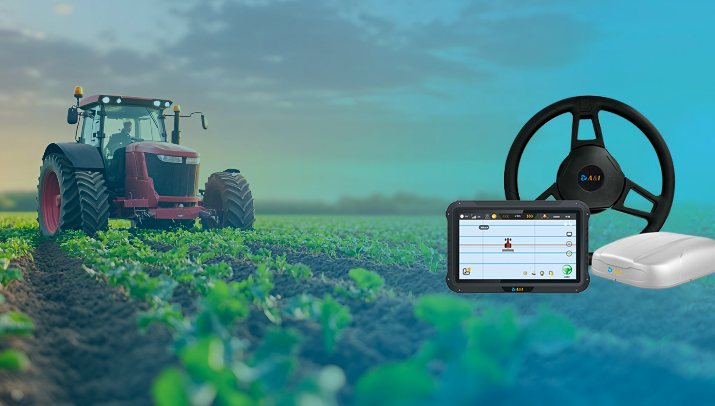
Smart agriculture farming is transforming how farmers manage crops, equipment, and resources. Modern farms now rely on connected systems that improve operational efficiency, reduce waste, and support accurate field management. Technologies such as GNSS positioning, artificial intelligence, IoT sensors, and automated steering systems are becoming essential parts of modern farming operations. Many Archimedes Innovation solutions are designed to support these evolving agricultural needs through intelligent monitoring and automation systems.
GNSS and Positioning Technology in Smart Farming
High-precision positioning technology plays an important role in automated farming. GNSS receivers and RTK correction systems allow agricultural equipment to operate with centimeter-level accuracy. This improves field navigation, planting consistency, spraying precision, and harvesting efficiency.
The AS10 autosteering system from Archimedes Innovation supports multiple guidance modes and adapts to irregular farmland environments. These systems help operators maintain accurate routes while reducing overlap and missed areas during field operations.
Many modern farms also use dual antenna positioning modules and integrated navigation systems for reliable operation in complex environments. These technologies improve machine stability and support autonomous agricultural equipment.
IoT Sensors and Real-Time Monitoring
IoT technology allows farms to collect and analyze data from multiple sources in real time. Sensors can monitor soil moisture, crop health, temperature, humidity, and water levels. This information helps farmers make accurate decisions regarding irrigation, fertilization, and crop protection.
Research on smart agriculture platforms highlights the growing use of IoT and AI technologies for monitoring agricultural environments and improving resource management.
Automated monitoring systems also support predictive maintenance for agricultural machinery and improve operational visibility across large farming areas.
Artificial Intelligence and Automation Systems
Artificial intelligence supports smart decision-making in agriculture. AI platforms can analyze environmental data, detect crop stress, identify obstacles, and improve route planning for autonomous equipment.
Many precision agriculture companies are integrating AI computing platforms with cameras, radar systems, and perception sensors to improve automation capabilities. These technologies support safer and more efficient farming operations.
Conclusion
Modern agriculture continues to adopt intelligent technologies that improve automation and monitoring capabilities. From GNSS guidance systems to AI-powered monitoring platforms, farms are becoming more connected and data-driven. Through advanced precision agriculture solutions, companies like Archimedes Innovation help support efficient and reliable farming operations for modern agriculture.
