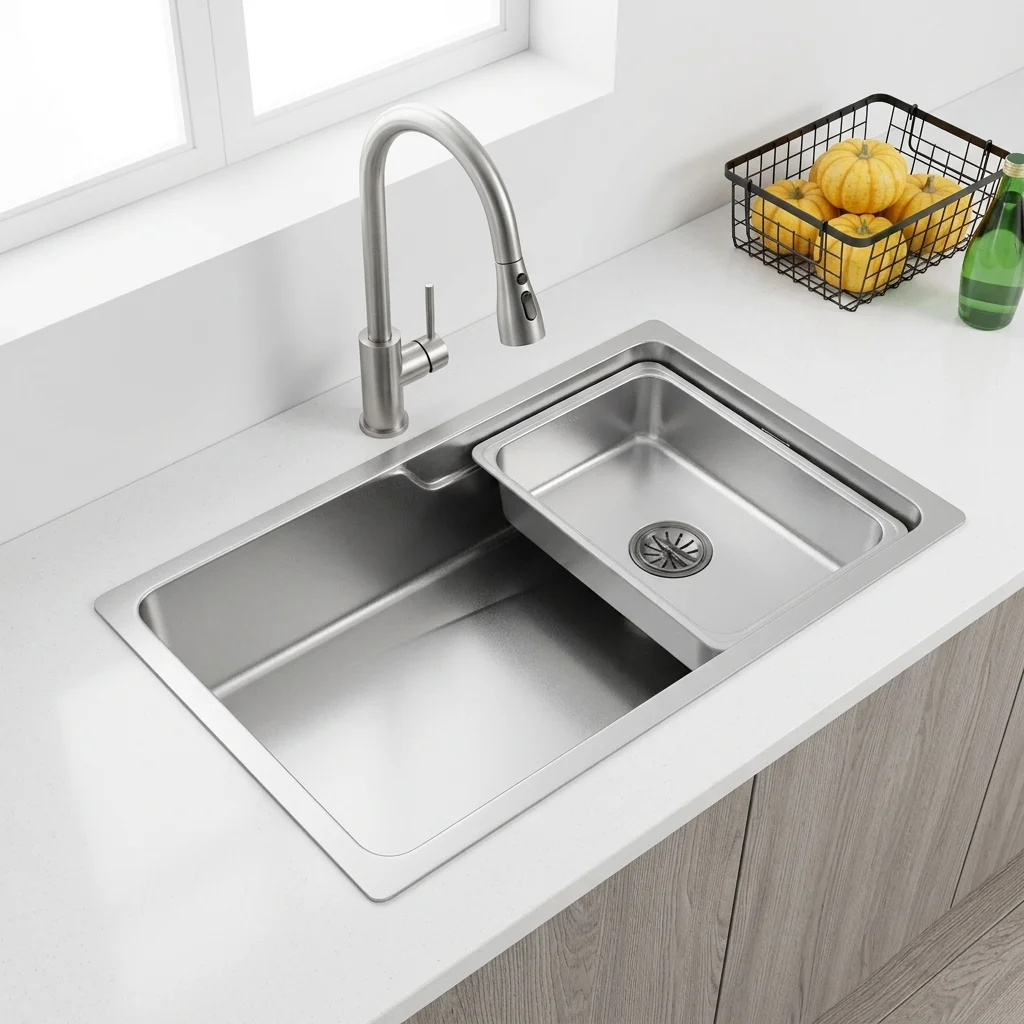
For kitchen designers, cabinetry manufacturers, property developers, and hospitality procurement teams, countertop integration affects both appearance and installation efficiency. An undercounter kitchen sink sits beneath the countertop rather than overlapping its upper surface with a visible rim.
This arrangement creates a continuous worktop edge, supports straightforward surface cleaning, and gives contemporary kitchens a streamlined appearance. Selecting the right model, however, requires attention to countertop compatibility, installation tolerances, material specifications, and long-term maintenance.
Why Undermount Installation Creates a Cleaner Countertop
The principal advantage of an undermount design is the transition between the sink and the surrounding work surface. With no exposed sink rim resting above the counter, crumbs and small spills can generally be swept directly into the basin instead of collecting around a raised edge. This can simplify routine cleaning in residential developments, serviced apartments, hotel kitchens, and other projects where consistent housekeeping matters.
The installation also gives designers greater flexibility when coordinating countertop materials and cabinetry. Stone, quartz, and other suitable solid countertop surfaces can provide an uninterrupted visual line around the basin. The final result depends on the cutout, edge finish, sealant, and installation workmanship, so the mounting method alone does not guarantee a flawless appearance.
Project teams should confirm that the selected countertop material can support an undermount installation. The cabinet structure must accommodate the sink, plumbing, and any required mounting hardware. Installers should also verify the manufacturer’s instructions for support brackets, adhesive or sealant, and the finished cutout before fabrication begins.
Material Selection Determines More Than Appearance
Stainless steel is widely used for kitchen sinks because it combines formability, practical maintenance, and corrosion resistance. However, buyers should distinguish between stainless steel grades instead of assuming that all products offer equivalent performance.
Grade 316 stainless steel contains molybdenum, which improves resistance to certain forms of corrosion, particularly in chloride-containing environments, compared with standard grade 304. This characteristic can make it a useful option for demanding applications, although actual performance still depends on exposure conditions, cleaning chemicals, fabrication, and maintenance.
Thickness is another purchasing consideration. A product’s stated thickness should be checked against its technical specification, and buyers should clarify whether a figure describes the basin material, a reinforced section, or a combined construction. A thicker component does not automatically guarantee superior overall performance: formed geometry, corner design, mounting support, and manufacturing quality also influence structural behavior.
For distributors and project buyers, documented specifications are more useful than broad claims such as “premium quality.” Material certificates, dimensional drawings, sample inspections, and clearly defined acceptance criteria help procurement teams compare suppliers on consistent terms.
What to Check Before Specifying Stainless Steel Undermount Kitchen Sinks
When comparing stainless steel undermount kitchen sinks, commercial buyers should assess the complete installation rather than evaluating the basin in isolation.
First, confirm the external dimensions and internal bowl capacity against the project drawings. A sink must fit the available cabinet while leaving sufficient room for drainage connections and other plumbing components.
Second, inspect the corner geometry and surface finish. Rounded internal corners may make certain areas easier to clean, while the finish should suit the project’s appearance and maintenance expectations.
Third, establish how the sink will be supported. Because an undermount basin hangs beneath the countertop, the installation system must carry its weight and the loads expected during normal use. The countertop fabricator and installer should agree on the appropriate support method before production and installation schedules are finalized.
Finally, review the supplied accessories and package contents. Cutting boards, strainers, drain assemblies, and other components should be confirmed against the actual order specification. Their presence should never be assumed simply because a product photograph shows them.
Product Specifications and Supplier Coordination
AOGLAN’s Ag-316-01 illustrates how a defined specification can support B2B product evaluation. The model uses 316 stainless steel and has an R5 rounded-corner design. It is available in various product sizes, including 680 × 430 × 230 mm, 750 × 430 × 230 mm, 720 × 450 × 230 mm, and 780 × 450 × 230 mm. It is a spacious and multifunctional sink with a thickness of 4 mm + 0.9 mm. The surface treatment is either black volcanic turbine silver diamond nano or volcanic diamond. The installation method is undermount.
These details provide a starting point for comparing the product with project drawings and buyer requirements. Before ordering, purchasers should confirm the intended size, interpretation of the thickness specification, finish, accessories, and installation details in writing.
Supplier coordination is equally important when multiple projects require the same model. AOGLAN has an in-house research and design team, more than 300 sink mold sets, and OEM/ODM customization capabilities. Its monthly production capacity of 20,000 pressed sink parts and 15,000 handmade sinks. Buyers should confirm current capacity, material availability, quality-control procedures, and order-specific lead times rather than treating general production figures as a delivery guarantee.
A Better Specification Process for Modern Kitchens
An effective undermount sink specification balances visual design with measurable installation and supply requirements. Designers should finalize countertop compatibility and cutout dimensions early, while procurement teams should verify materials, construction, accessories, inspection standards, and delivery commitments before approving production.
For distributors, contractors, and kitchen-equipment importers seeking a manufacturing partner, AOGLAN offers stainless steel sink products alongside OEM/ODM services. A detailed project brief covering dimensions, material grade, finish, quantity, packaging, and delivery deadlines helps both parties establish clear expectations and reduce avoidable discrepancies between the approved sample and delivered order.
