Camera movements during high-end film and commercial recording generate substantial rotational torque across camera supports. Panning heavy cinema rigs or tilting long lenses exposes structural flexing in conventional single-tube leg assemblies, causing subtle jitter or framing shift during dynamic tracking sequences.
Rigorous production schedules require camera platforms that unite rapid setup protocols with dependable mechanical stability under real-world shooting conditions. Evaluating twin-leg carbon-fiber geometry determines whether dual-tube structures truly satisfy the stringent performance expectations of cinema crews and commercial video teams.
Structural Rigidity and Apex Connection Under Dynamic Loads
Dual-tube construction fundamentally alters how mechanical forces disperse across a camera support frame during active camera moves. Utilizing two parallel carbon tubes on upper leg segments increases torsional stiffness, resisting the rotational twisting forces produced when operators pan against heavy fluid drag.
Engineered by Leofoto, the LVF-143C+FH-5L Boring series configuration pairs dual carbon tubes with two discrete connection points at the apex platform. Anchoring each leg at two distinct contact positions distributes downward mass across a broader structural footprint than single-point hinge designs.
Selecting a dedicated videography tripod requires verifying how structural geometry handles angular drag and substantial payload demands. Stated to support a 20 kg maximum platform payload, this twin-leg structure features four composite tubes per leg to maintain structural firmness while carrying comprehensive cinema assemblies.
Lightweight carbon-fiber construction maintains high strength characteristics while reducing overall transport mass to 4.46 kg for the complete system. This material selection keeps field transport practical without sacrificing the physical rigidity demanded by cinema cameras, matte boxes, and studio monitor cages.
Half-Bowl Leveling Architecture and Fluid Motion Performance
Rapid leveling remains an essential mechanical requirement on professional film sets, where uneven surfaces frequently complicate horizon alignment. Integrating a 75 mm half bowl directly into the spider removes the requirement of mounting separate bowl adapters before installing fluid heads, streamlining base setup.
Cinematographers recognize that a good carbon-fiber tripod must integrate bowl leveling directly into the chassis to enable swift horizon correction without shifting individual leg extensions. Releasing the half-ball grip allows smooth angular adjustments so operators can level shots quickly between repositioned takes.
Motion stability relies directly on matched head mechanics, where the Leofoto FH-5L fluid head incorporates ergonomic fluid tension controls for 360-degree panning alongside controlled tilt dampening. Fluid resistance moderates camera inertia during sudden starts and stops, supporting deliberate visual transitions across complex tracking scenes.
Controlled tilt motion spans an angle from positive 90 degrees to negative 60 degrees, accommodating high-angle downward monitoring and steep upward framing. Maintaining reliable tilt lock resistance across this range keeps mounted cinema cameras stationary at chosen angles without unwanted slippage or payload sag.
Deployment Speed and Multi-Angle Positioning Mechanics
Studio workflows and fast-paced commercial shoots place premium value on immediate height adjustments during lighting and staging changes. A one-button unlocking design permits quick single-action height changes, allowing operators to raise or lower the frame without loosening multiple mechanical clamps on each leg.
Field crews operating a modern videography tripod frequently need rapid reconfiguration between takes to capture dynamic perspectives. Offering two methods of adjustment alongside three selectable angle stops allows operators to set leg spread angles reliably across narrow interior sets or broad exterior terrain.
Elevating camera packages to a maximum height of 1620 mm enables eye-level compositions, while descending to a minimum height of 350 mm supports low-angle perspective capture. Folding down to 860 mm in length preserves storage convenience and simplifies packing into production vehicles between remote shoot locations.
Accessory Integration and Surface Stability in the Field
Dedicated cinema production setups demand modular mounting points to support field monitors, wireless transmitters, and operational handles. A custom-designed tripod handle manufactured from stainless steel, TPE, PA, PC, and silicone mounts directly in horizontal or vertical orientations without requiring specialized installation tools.
Four anti-twisting location pins secure the handle firmly against rotational slippage, creating a dependable grip point for repositioning the loaded rig. Camera security also benefits from an automatic lock mechanism inside the press-and-release clamp, which protects camera plates from accidental disengagement when loosening mounts.
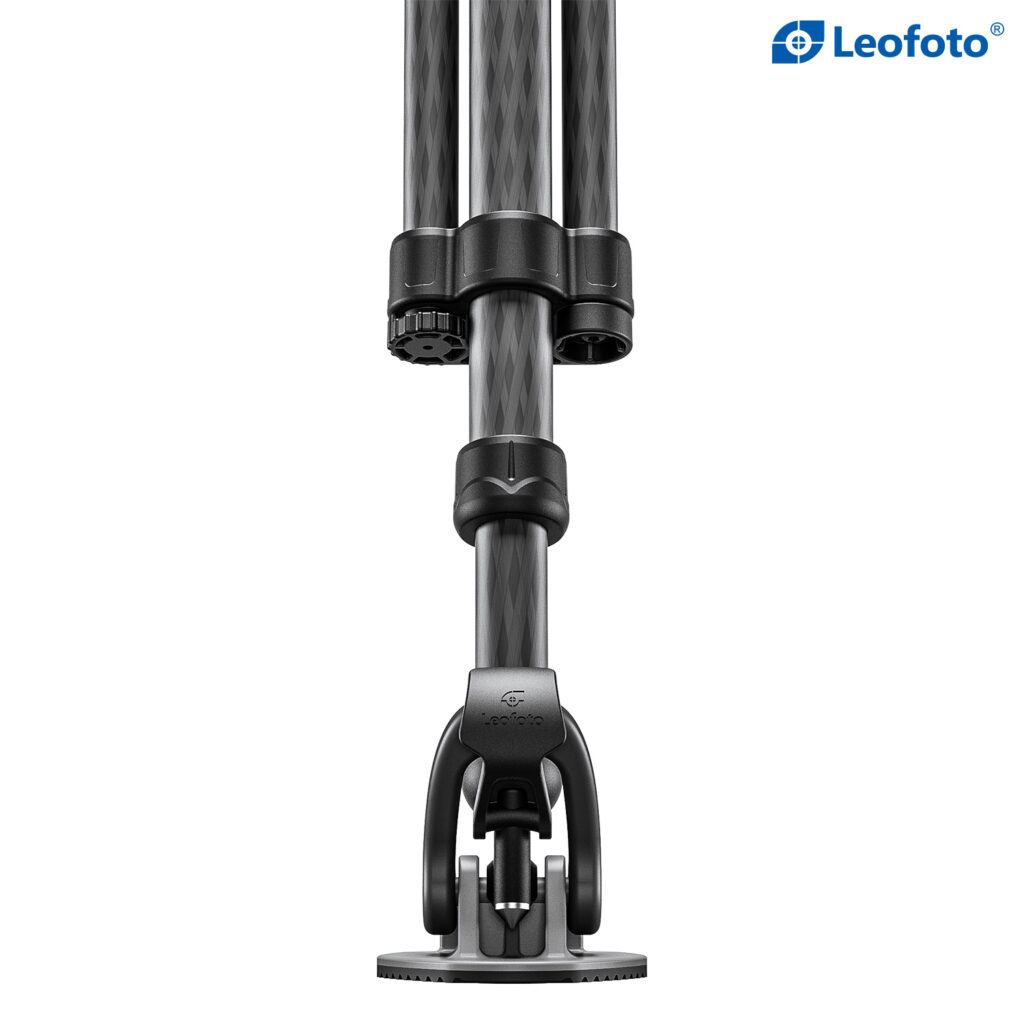
Working outdoors proves that a good carbon-fiber tripod should adapt seamlessly to soft turf and slick flooring alike. Outfitted with hoof-shaped rubber feet for smooth studio floors, the legs switch easily to stainless steel spike feet for positive traction on soil, loose gravel, or slippery ground.
Practical Suitability for Modern Cinematography Workflows
Assessing whether twin-leg carbon-fiber engineering fulfills the demands of professional motion picture production requires examining how these structural elements function collectively. Dual apex connection points counteract rotational torsion during panning moves, which directly addresses the structural weaknesses observed in standard single-tube designs.
Combining composite materials with dual-tube architecture demonstrates how a good carbon-fiber tripod delivers commercial rigidity without unnecessary equipment weight. The composite framework damps mechanical vibrations, providing a stable foundation for telephoto recording and precise visual tracking.
Dual-Tube Geometry, Safety Features, and Operational Speed
Built-in safety features, such as the silver release button on the Arca-Swiss compatible clamp, defend valuable cameras against sudden release hazards. Meanwhile, dual leg tubes with two apex mounting points engineered by Leofoto provide the rigid geometry necessary to stabilize fluid head movements during continuous panning sequences.
Evaluating whether such a videography tripod suits demanding production sets comes down to balancing structural rigidity against operational speed. By pairing dual-tube torsional stability with one-button adjustment mechanics and integrated 75 mm bowl leveling, this design directly satisfies the rigorous performance requirements of high-end video recording.
