Rail transportation, wind power generation, and industrial power conversion systems rely on semiconductor switching devices to manage electrical energy efficiently and reliably. Insulated-gate bipolar transistors (IGBTs) remain widely used in high-power converters, while silicon carbide (SiC) devices are increasingly considered for applications requiring higher switching frequencies or improved power density. Across these systems, appropriate gate-drive design is essential for controlling switching behavior, protecting semiconductor modules, and maintaining stable operation under demanding electrical and thermal conditions.
Why Gate-Drive Performance Matters in Power Electronics
A gate driver translates control signals into the voltage and current required to switch a power semiconductor on and off. Its performance influences switching speed, conduction and switching losses, electromagnetic interference, and the electrical stress experienced by the device.
A suitable gate driver for IGBT applications must provide appropriate gate voltage, sufficient peak current, and reliable protection against abnormal operating conditions. When selecting a gate driver for IGBT modules, engineers should also consider switching frequency, load conditions, and converter topology. The required characteristics depend on the semiconductor module, DC-link voltage, switching frequency, load profile, and converter topology.
Gate-drive design also affects system integration. Engineers must consider isolation, electrical interfaces, thermal limits, circuit layout, and fault communication when selecting a solution. These factors become particularly important in equipment expected to operate continuously, where unplanned downtime can increase maintenance costs and disrupt operations.
Rail Applications: Reliability Under Demanding Operating Conditions
Rail traction systems experience frequent acceleration, braking, and load variation. Their power converters must handle substantial electrical currents while operating within demanding thermal and environmental limits. Semiconductor switching performance therefore affects both energy conversion and equipment reliability.
An effective gate-drive solution helps control switching transitions and provides protection against conditions such as short circuits and inadequate gate-drive supply voltage. Undervoltage lockout (UVLO) prevents normal switching when the supply falls below a defined threshold, reducing the risk of operating a semiconductor with insufficient gate voltage.
For rail engineers, selecting IGBT driver boards involves evaluating the module’s electrical ratings, gate-voltage requirements, protection response, and compatibility with the converter architecture. Engineers should also verify that the IGBT driver boards support the required electrical interfaces and protection functions. Testing should cover representative operating temperatures, load conditions, and fault scenarios rather than relying solely on nominal specifications.
Wind Power: Balancing Efficiency and Switching Stress
Wind turbines use power converters to manage the electrical output of generators and coordinate power delivery to the grid. Converter designs must accommodate changing generation conditions while maintaining controlled electrical performance.
Switching losses contribute to semiconductor heating and influence cooling-system requirements. Increasing switching speed may reduce transition losses, but it can also increase voltage overshoot and electromagnetic interference when circuit parasitics are not adequately controlled. Engineers must balance these effects when selecting gate resistance, switching frequency, and protection settings.
A gate driver for IGBT systems should therefore be assessed alongside the power module, busbar arrangement, cooling design, and converter control strategy. Short-circuit protection, controlled shutdown, and reliable fault reporting can support system-level protection, although the complete converter still requires coordinated safeguards and validation.
Industrial Power Systems and High-Power-Density Designs
Industrial motor drives, energy storage systems, and other power conversion equipment have different operating requirements, but they share the need for predictable switching and effective fault management. Motor drives may encounter frequent load changes, while energy storage converters must support controlled power transfer during charging and discharging.
Compact driver designs can simplify integration where cabinet space and power density are important. However, engineers should evaluate peak gate current, output capability, operating temperature, electrical interface, and semiconductor compatibility together. The selected IGBT driver boards should match the module manufacturer’s recommended gate-drive conditions and the converter’s operating requirements. Higher peak current alone does not guarantee lower switching losses or improved overall efficiency.
For applications using SiC MOSFETs as well as IGBTs, gate-voltage requirements deserve particular attention. Positive and negative gate voltages, Miller clamping, and switching behavior vary by device and application. A driver must match the specific module manufacturer’s recommendations rather than assuming that one configuration suits every semiconductor technology.
Firstack 2FHD0220: Features for Industrial Integration
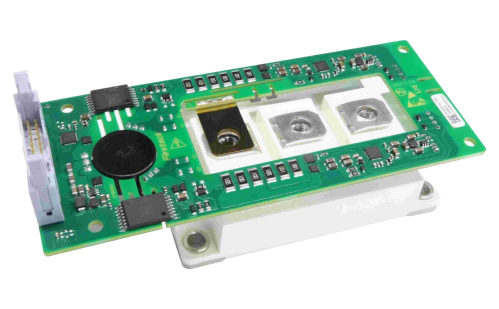
Firstack specializes in the research, development, and sales of power semiconductor drivers, power stacks, and testing equipment. Its 2FHD0220 series is a dual-channel gate driver developed on an ASIC platform for applications involving IGBT and SiC MOSFET modules in 62 mm housings.
The supplied product information identifies support for two-level topology, a peak gate current of 20 A, and configurable gate voltage. The stated positive gate-voltage range is 15–20 V, while the negative range is −2 to −4 V. The driver is specified for operating ambient temperatures from −40°C to 85°C and supports Box Header Connector and distributed NTC sampling.
Protection functions include short-circuit protection with soft shutdown, UVLO, Miller clamping, and intelligent fault management. These functions are relevant when engineers need to manage abnormal switching conditions and monitor thermal information within a power assembly. The product information also identifies support for modules rated up to 2000 V in the 62 mm housing format.
Before selecting the 2FHD0220, engineering teams should confirm the exact module compatibility, output-power requirements, gate-voltage configuration, and applicable technical documentation. The supplied summary and detailed specifications should also be reconciled during procurement, particularly where output-power ratings differ between product descriptions.
Engineering Validation Before Deployment
A suitable driver selection should be followed by laboratory validation. A gate driver for IGBT applications should be tested under representative switching and load conditions. Double-pulse testing can help engineers examine switching energy, voltage overshoot, current behavior, and gate waveforms. Thermal testing can establish whether the driver and semiconductor assembly remain within their specified operating limits.
Protection testing should examine short-circuit response, undervoltage behavior, and shutdown transients under controlled conditions. Engineers should also assess signal integrity, electrical noise, and fault reporting within the intended converter architecture. These checks help identify integration issues before equipment enters service.
Building More Reliable Power Conversion Systems
Rail, wind, and industrial power applications demand a careful balance of switching efficiency, electrical stress, and protection. By matching driver characteristics to semiconductor requirements and validating performance under realistic operating conditions, engineering teams can make better-informed design decisions. Firstack‘s 2FHD0220 provides a set of documented drive and protection features for relevant power-electronics applications, while final suitability depends on module compatibility, system requirements, and thorough engineering verification.
