Coatings can look stable under controlled indoor conditions yet change after months of sunlight, heat, moisture, and repeated wetting and drying. Xenon arc weathering tests reproduce and accelerate these outdoor degradation stresses in a precisely controlled laboratory environment, allowing coating developers and quality assurance teams to systematically evaluate the durability and performance changes of a finish well before long-term outdoor exposure becomes the sole basis for performance validation.
Why Xenon Exposure Matters for Coatings
Natural weathering is valuable, but outdoor conditions vary by season, location, orientation, and climate. A xenon aging test provides a more controlled way to expose coated specimens to radiation while regulating other test conditions. Xenon-arc systems are designed to reproduce parts of the solar spectrum, and recognized methods such as ISO 16474-2 and ASTM D6695 are used for laboratory exposure of paints and related coatings.
The purpose is not simply to make a coating fail faster. A properly designed exposure helps researchers compare formulations, identify sensitive materials, and observe changes under repeatable conditions. This is especially useful when several coating systems appear similar at the beginning of a project but may behave differently after sustained environmental stress.
Visible Changes That Can Indicate Durability Loss
One of the first areas to evaluate is appearance. After controlled exposure, a coating may show changes in color, gloss, surface chalking, cracking, blistering, or flaking. These observations can reveal whether pigments, binders, additives, or the coating structure are responding poorly to radiation and moisture.
Color change can be important for decorative and automotive finishes, while gloss retention may matter when a uniform surface appearance is part of the product requirement. Surface cracking or flaking can indicate a more significant loss of coating integrity. The key is to compare exposed specimens with unexposed controls and use consistent evaluation procedures rather than relying only on visual impressions.
What the Test Reveals Beyond Appearance
A xenon aging program can support more than a simple before-and-after inspection. By recording exposure conditions and evaluating specimens at planned intervals, laboratories can build a clearer picture of how formulation changes over time.
The resulting data can show whether a coating maintains its original color and gloss, whether degradation becomes more noticeable after extended exposure, and how different formulations behave under the same environmental conditions. Changes in the surface may also provide clues about the combined effects of radiation, heat, and moisture. When results are compared with the criteria of a relevant specification, the test can further support decisions about formulation development, quality control, and product qualification.
Why Test Conditions Need Tight Control
The value of an aging test depends heavily on exposure consistency. Irradiance, black panel or black standard temperature, chamber temperature, humidity, spray conditions, and specimen positioning can all influence the test environment. If these factors vary unnecessarily, differences between specimens become harder to interpret.
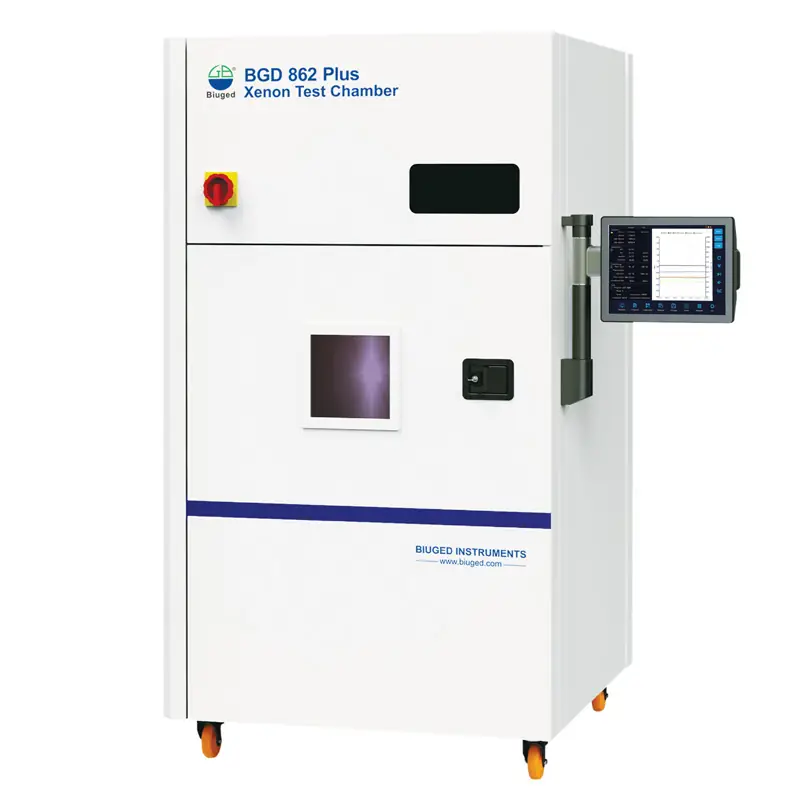
This is why a modern xenon arc test chamber should provide controlled and traceable operating conditions rather than only a powerful light source. The BGD 862 Plus, for example, uses a 6.5 kW water-cooled xenon lamp and a 6,500 cm² exposure area. Its control system can monitor irradiance at 340 nm, 420 nm, 300–400 nm, and 300–800 nm, while temperature and humidity are automatically controlled. The chamber also supports spray cycles and rotating sample placement to improve exposure uniformity.
These features are relevant when laboratories need comparable results across larger batches of coated panels or when different test programs must be repeated over time. The system also supports programmable test methods, data export, and remote monitoring, which can make long-duration testing easier to manage.
Turning Aging Results into Better Coating Decisions
Aging data becomes more useful when it is connected to the actual service environment and evaluation criteria. A coating intended for outdoor architectural use may require different exposure priorities from an interior decorative finish or an automotive exterior material. Test standards, substrate type, film thickness, exposure cycle, irradiance, and performance criteria should therefore be defined before the test begins.
It is also important to avoid treating accelerated aging as a direct calendar conversion. A laboratory exposure can reproduce selected environmental stress under controlled conditions, but real-world weathering involves complex interactions that may not follow a simple one-to-one time relationship. Results are most informative when used for comparative evaluation, formulation development, quality verification, and standard-based testing.
For laboratories handling multiple coating projects, consistent instrumentation also supports historical comparison. When the chamber, method, and evaluation process remain stable, teams can build internal datasets that reveal whether a formulation change produces a meaningful improvement or simply shifts one failure mode to another.
Using Controlled Aging to Strengthen Quality Evaluation
A xenon lamp aging test can reveal how coatings respond to sustained radiation and environmental stress, from early appearance changes to more serious surface degradation. The most useful results come from controlled exposure conditions, appropriate standards, consistent specimen preparation, and objective evaluation after defined exposure intervals.
BIUGED INSTRUMENTS develops material testing equipment for coatings and related materials, with its BGD 862 Plus designed for large-area xenon accelerated weathering applications. The system combines controlled irradiance, temperature, humidity, spray, programmable testing, and data management functions to support repeatable laboratory evaluation.
For coating laboratories that need repeatable weathering evaluation and systematic test management, BIUGED INSTRUMENTS offers tailored xenon testing solutions and dedicated technical consultation to help you define optimized test configurations for your specific application requirements.
