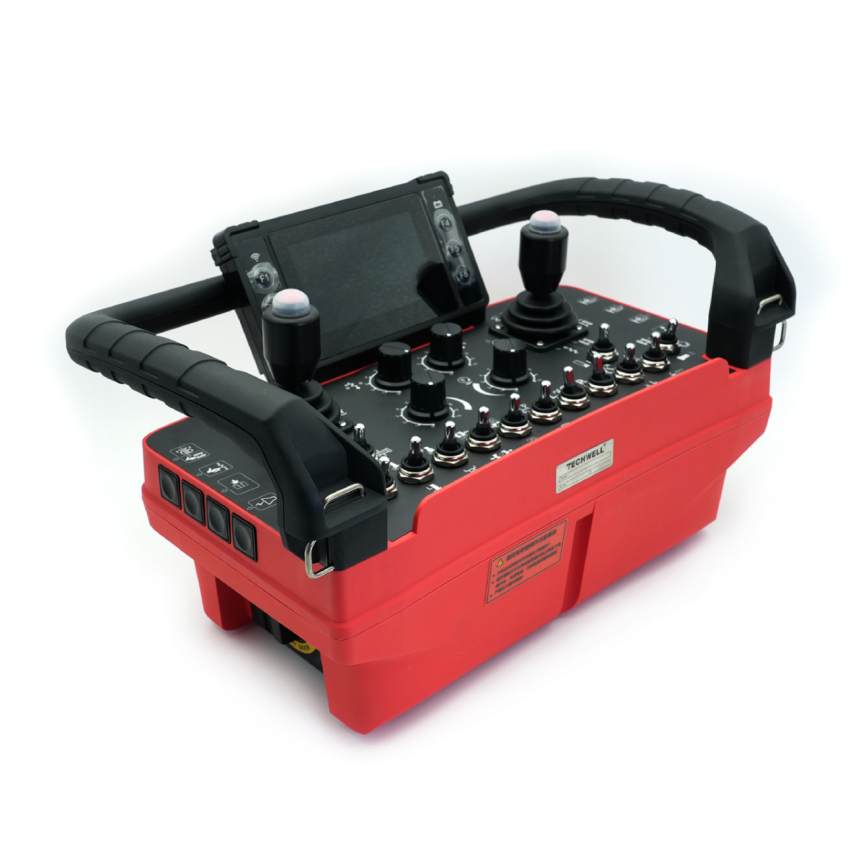
Not every crane operation can be managed with a simple handheld unit and a handful of buttons. Overhead cranes, hydraulic machinery, and complex hoisting equipment often demand coordinated control of multiple functions — such as travel, hoisting, and rotation — requiring operators to manage several machine movements through the transmitter’s joysticks or buttons. This is the gap that belly box, or shoulder-mounted, controllers are designed to fill. Worn against the body rather than held, they free up the operator’s hands while still delivering the fine control that heavier machinery requires.
What Sets a Belly Box Apart from a Handheld Unit
A belly box controller is typically supported by a shoulder strap or harness, allowing operators to carry the unit against the body rather than hold it continuously in their hands. Its larger housing also provides more space for control components such as multiple buttons, joysticks, and rotary switches. Techwell’s BL300 weighs 3.2 kg and uses an engineering-plastic housing in a shoulder-mounted design intended for demanding industrial applications. It also opens up space for a larger control surface — more buttons, dual joysticks, rotary switches — than a compact handheld unit could reasonably accommodate. Techwell’s BL300 illustrates this design approach directly.
Control Layout for Complex Machinery
The larger panel size on a belly box unit isn’t just about ergonomics — it also allows for a more capable control layout. The BL300 combines joystick controls with configurable buttons and switches, allowing the control layout to be adapted to different machinery requirements. Joystick count and switch layout can be configured to match the specific machine being controlled, rather than forcing an operator to work around a fixed, generic layout. For overhead cranes and hydraulic equipment that require several coordinated motions, this kind of configurable layout allows the control arrangement to be matched more closely to the machine’s operating requirements.
Display Options and Functional Safety
The BL300 supports optional 3-inch, 4.3-inch, and 7-inch displays, allowing buyers to select a screen size according to their monitoring requirements. Additional options include a 3-axis sensor and video feedback for applications that require supplementary operating information. The BL300 also carries SIL2 certification for applicable safety-related functions, providing a relevant functional safety reference when evaluating the controller for industrial machinery. These display and safety-related options should be assessed according to the actual equipment requirements and system configuration.
Signal Range and Frequency Design
The BL300 supports dual-band operation, with available frequency ranges of 427.000–436.300 MHz and 472.350–485.775 MHz. This design provides additional frequency configuration options for projects with different radio communication requirements. The appropriate operating band should be selected according to the transmitter-receiver configuration, local frequency requirements, and the radio environment at the installation site. For applications involving multiple wireless control systems, frequency planning and compatibility between devices remain important considerations.
Durability for Continuous Industrial Use
A device carried against the body for an entire shift still needs to meet the same durability standards as any other piece of outdoor industrial equipment. The BL300 carries an IP66 protection rating and operates across a -25°C to 70°C range, with humidity tolerance up to 97% RH in non-condensing conditions — specifications aligned with the demands of construction sites, hoisting yards, and other environments where dust and temperature swings are a daily reality rather than an occasional concern. These specifications provide reference points when assessing the BL300 for applications involving dust, moisture, and temperature variations. Actual suitability should be evaluated against the environmental conditions and protection requirements of the intended application.
Techwell’s testing facilities also include equipment for electromagnetic compatibility evaluation, electrostatic discharge, electrical fast transient, lightning surge, and vehicle electronic transient interference testing. These tests address different potential sources of electrical and electromagnetic disturbances that may affect industrial electronic equipment. Their relevance depends on the operating environment and the applicable testing requirements for each product.
Safety Certification for Heavy Equipment Control
Given the scale of equipment a belly box controller typically operates, safety certification carries real weight. Techwell states that the BL300 is SIL2 certified, a functional safety designation relevant to systems where a malfunction could have significant operational consequences. The BLJ20 is SIL2 certified for applicable safety-related functions, while its operating current and transmit power are separate electrical specifications.
Applications Across Heavy Machinery
Techwell positions the industrial radio remote control as suited to overhead cranes, heavy-duty lifting operations, construction equipment, and hydraulic machinery, and the company also states that the unit’s customizable joystick and switch layout make it applicable to electric hoist control. This range of applications reflects the underlying logic of the belly box format itself: equipment that requires coordinated, multi-function input over extended operating periods may benefit from a wearable control layout when the application requires multiple control functions and a larger operator interface.
Conclusion
A belly box controller exists to solve a specific ergonomic and functional problem — giving operators of complex, heavy machinery a control device that combines a larger configurable control interface with optional display functions and IP66 protection for industrial applications. The BLJ20 illustrates this approach with a wearable joystick transmitter designed for cranes, hoists, and other heavy industrial equipment.
